
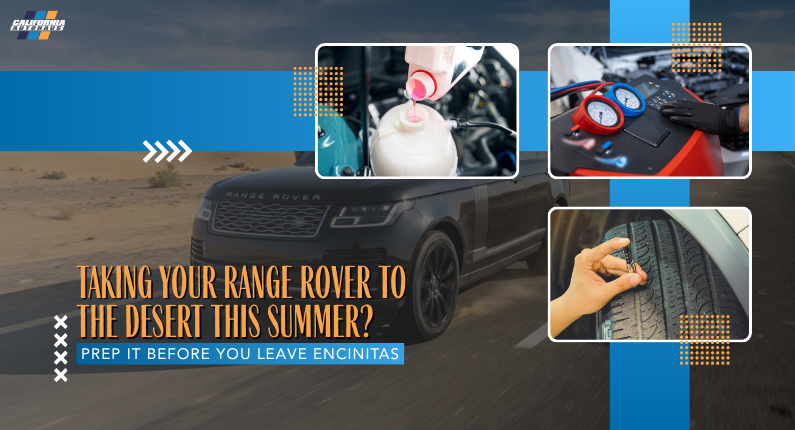
You point the Range Rover east out of Encinitas, up the 78, then out toward Borrego Springs where the July air sits at 108 degrees by noon. Coastal weather babies a cooling system. The desert exposes it. A Land Rover that runs fine on the 5 near Carlsbad can boil over an hour inland, and the tow back is long and expensive.
So prep it first. Ten minutes of checking before you load the cooler beats sitting on the shoulder of S-22 with steam under the hood. Here’s what we look at before we’d send our own truck into that heat.
Quick Summary: Key Takeaways
- Cooling comes first: Plastic coolant crossover pipes, the thermostat, and the water pump are the parts that quit when desert heat stacks on a climb.
- AC is not optional out there: A weak compressor or low refrigerant turns a 108-degree drive into a health risk, not just a comfort one.
- Check the tires cold: Underinflated tires build heat fast on hot asphalt, and blowouts spike in summer.
- Carry water and coolant: A gallon of each and a real spare have saved plenty of desert weekends.
- We back the repair: Qualifying work carries our 3-year/36,000-mile warranty.
The Cooling System Is What Fails First in Desert Heat
The cooling system is the part most likely to leave you stranded past Ranchita, so it gets checked first. Range Rovers lean on plastic. The coolant crossover pipe sits in the valley of the V8 and cracks with age, and once it weeps, you lose coolant somewhere you can’t even see it. Thermostats stick. Water pumps seep.
None of it is exotic. It’s ordinary wear that coastal driving hides and a desert grade drags into the open, usually right when the outside temperature is already fighting you and the AC compressor is dumping extra heat into the same radiator. We pressure-test the system and read it on factory-level tools before you go.
Your AC Has to Work When It’s 108 Outside
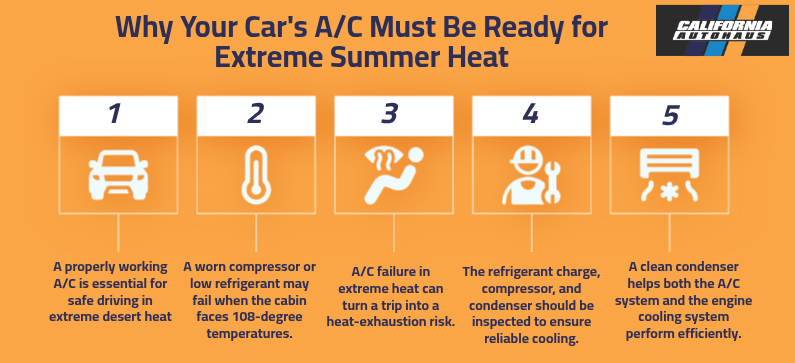
Working AC is a safety item on a desert run, full stop. A compressor that’s tired or a system that’s a half-pound low will limp along at the beach and then quit entirely when the cabin is fighting 108-degree air off the Anza-Borrego floor. That’s how a fun weekend turns into a heat-exhaustion scare.
We check refrigerant charge, the compressor, and the condenser sitting ahead of the radiator. A clean condenser also helps the engine run cooler, so the AC service and the cooling service go hand in hand.
Hot Asphalt Punishes Tires, So Check Them Cold
Tires are the other summer breakdown you can prevent in five minutes. Heat and underinflation together are what shred a sidewall at 75 mph, and desert asphalt in July can run 40 degrees hotter than the air above it. Set the pressures cold, before you drive, to the door-jamb spec for a loaded truck.
Look at tread and age too. A ten-year-old spare that’s never touched the ground is not a spare you want on S-22. Bring a real one.
A Long Grade in July Is the Real Test
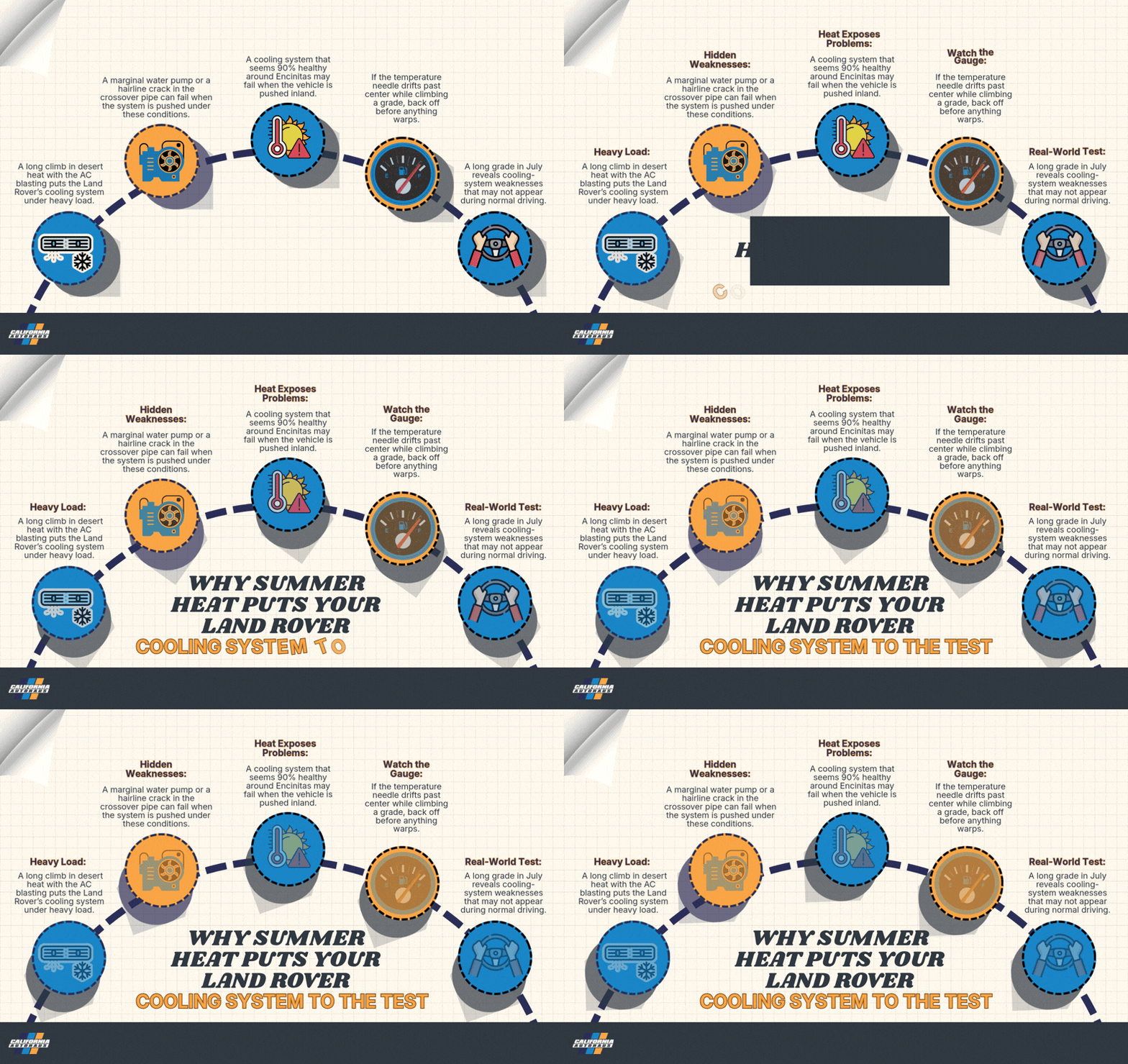
Cooling systems fail under load, and nothing loads a Land Rover like a long climb in desert heat with the AC blasting and the truck packed for a weekend, which is exactly the moment a marginal water pump or a hairline crack in the crossover pipe finally gives up. A system that’s 90 percent healthy is fine around Encinitas. Push it inland and that last 10 percent is where it quits.
Watch the gauge, not just the warning light. A needle drifting past center on the grade is your cue to back off before anything warps.
Why Encinitas Land Rover Owners Prep With Us
We’re an independent European shop in a 9-bay building on Encinitas Blvd, just east of I-5, and Land Rovers are a big part of the work. Owners from Rancho Santa Fe, Solana Beach, and Carlsbad bring us the trucks other shops won’t touch. We’ve been at it since 2005, we run the same diagnostic platforms the dealer uses, and we won’t sell you a repair the truck doesn’t actually need.
Straight answers, no upsell. We mean it. According to AAA, AAA expected to rescue 7.7 million drivers over the summer of 2025, and an overheated cooling system is one of the top reasons a summer trip ends on a flatbed. Don’t be that stat.
Frequently Asked Questions
Q: How do I keep my Range Rover from overheating in the desert?
A: Have the cooling system pressure-tested before the trip, top off with the correct Land Rover coolant, and confirm the AC and condenser are clean and working. Watch the temperature gauge on long climbs and back off if the needle drifts past center. Most desert breakdowns start as a small coolant leak that was ignored.
Q: Is it safe to drive a Land Rover that’s running a little hot?
A: No. If the gauge climbs into the red or you smell coolant, pull over and let it cool. Driving an overheating V8 is how a couple-hundred-dollar pipe becomes a warped head and a repair in the thousands. Get it towed if it won’t come back down.
Q: What should I carry in a Range Rover for a summer desert drive?
A: A gallon of drinking water per person, a gallon of the correct coolant, a real full-size spare, and a basic tool kit. Cell coverage drops fast past Ranchita, so tell someone your route and expected return time before you leave Encinitas.
Q: How much does Range Rover cooling repair cost near Encinitas?
A: A single failed thermostat or hose is often a few hundred dollars. A water pump or radiator runs more. If overheating has already cooked a head gasket, you’re into the thousands, which is why the pre-trip check is worth the ten minutes.
Book a Pre-Trip Check Before Your Desert Weekend
Planning a run to Borrego or beyond this summer? Bring the Range Rover in first and leave with a truck you trust.
California Autohaus – 386 Encinitas Blvd, Encinitas, CA 92024
Hours: Monday-Friday, 8:00 AM – 5:30 PM
Website: californiaautohaus.com