
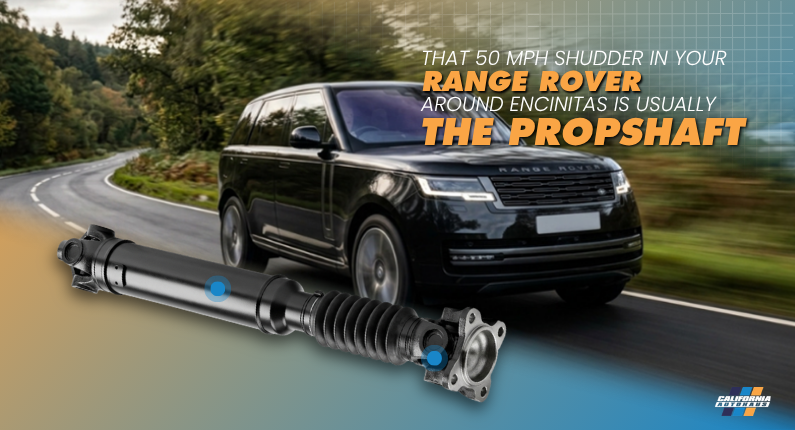
It only happens in a window. Smooth up to about 40, a buzz through the floor and the seat from 45 to 60, then smooth again once you settle at freeway speed on the 5. Nothing shows on the dash. Your tires were balanced last month. On a Range Rover or an LR4, that speed-specific shudder is the propshaft and its universal joints, and it does not improve on its own.
October is a sensible month to sort it. Encinitas drivers head inland and out to the desert once the heat breaks, and a dry U-joint that merely buzzes on Encinitas Boulevard behaves very differently loaded up on a long grade with the family and gear aboard.
Quick Summary: Key Takeaways
- Speed window, not speed range: A driveline vibration appears between roughly 40 and 60 mph and fades above it. A tire or wheel problem gets worse the faster you go.
- Sealed joints, no grease fitting: Most Land Rover propshaft joints cannot be greased, so once the seal hardens the joint runs dry and starts to wear.
- Clunk on direction change: A thud shifting between drive and reverse usually means play in a U-joint or the slip yoke, not the transmission.
- Replaced as an assembly: On many models the shaft is balanced as a unit, so the repair is a shaft, not a single joint.
- Covered work: Qualifying repairs at our nine-bay Encinitas shop carry a 3-year, 36,000-mile warranty.
The propshaft carries every bit of torque to the axles
A propshaft is a tube with a universal joint at each end and, on longer shafts, a centre bearing in the middle. The joints let the shaft change angle as the suspension moves. Constantly, on an air-sprung Range Rover. Each joint runs on four small needle bearings packed with grease and sealed for life, and when that grease dries the needles brinell into the cross. Play appears. At a particular rotational speed the imbalance hits its resonance and you feel it as a shudder.
That is why the vibration lives in a window. Speed sets the frequency.
Four symptoms that separate driveline from wheels
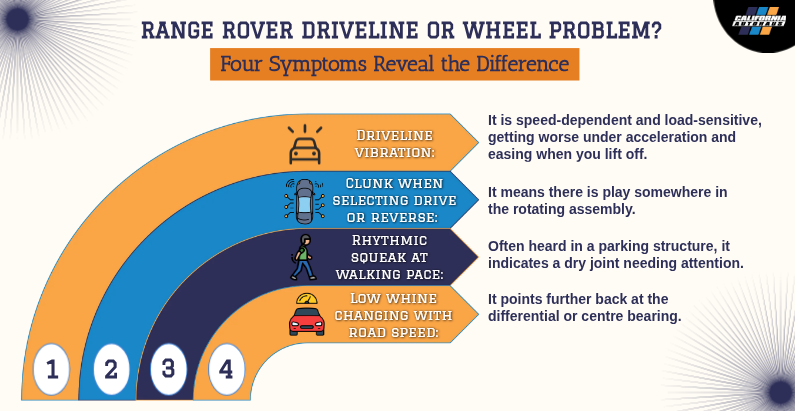
Start with the pattern rather than the part. A driveline vibration is speed-dependent and load-sensitive — it gets worse under acceleration and eases when you lift off. A clunk when you select drive or reverse means play somewhere in the rotating assembly. A rhythmic squeak at walking pace, often in a parking structure, is a dry joint asking for attention. And a low whine that changes pitch with road speed points further back, at the differential or the centre bearing.
A wheel or tire problem behaves differently. It follows speed steadily upward, it does not care about throttle, and it usually improves when the wheels are swapped front to rear.
Coastal air, high mileage and sealed joints do the damage
Three things wear these joints out. Mileage is the obvious one — most sealed U-joints start showing play somewhere past 80,000 miles. Heat from the exhaust and the transmission tunnel bakes the seals until they crack. And salt air off the coast, which every car parked near Leucadia or Cardiff lives in, corrodes the cross and the shaft flanges from the outside in.
Neglected basics accelerate all of it. The Department of Energy’s maintenance guidance points out that keeping tires at the correct pressure improves gas mileage by 0.6% on average and up to 3% in some cases, and the same underinflated tires that cost you fuel also change driveline angles and load the joints unevenly.
A worn propshaft does not fail politely
This is the part where waiting gets expensive. A U-joint with real play eventually seizes or separates, and a spinning shaft that comes loose at 60 mph takes out the transmission tunnel, brake lines, fuel lines and the exhaust on its way through. That is a tow, a flatbed and a repair bill several times the size of the one you were putting off.
Even short of that, play beats up everything it touches. Transmission and transfer case output seals, the centre bearing carrier and the differential pinion all wear faster with an unbalanced shaft spinning between them.
How the vibration gets pinned to a part, on the lift
Every driveline complaint starts with a road test, because the speed window and the throttle response tell us more than any scanner will. Then the vehicle goes up on the lift. Each joint gets checked by hand for radial and axial play, the centre bearing gets loaded, the shaft flanges and bolts get inspected for movement, and the transmission and differential mounts get pried to rule out a soft mount imitating a bad joint.
Wheels and tires get their own look — runout, balance and tread condition — before a driveline part is quoted. You get told which of those checks found the problem, and what it measured, rather than a guess dressed up as a diagnosis.
Frequently Asked Questions
Q: Why does my Range Rover vibrate at 50 mph but not at 70?
A: Because driveline imbalance has a resonant speed. A worn propshaft joint produces its worst vibration in a band, commonly 40 to 60 mph, and smooths out above it. Tire and wheel problems get steadily worse with speed instead, which is how the two are told apart on a road test.
Q: Can Land Rover propshaft universal joints be greased?
A: On most later models, no — the joints are sealed at the factory with no grease fitting, so they cannot be serviced. That is why inspection at each service matters: catching play early means replacing a shaft on your schedule rather than on the side of Interstate 5.
Q: How much play in a driveshaft U-joint is acceptable?
A: Effectively none. A healthy joint feels tight in every direction with no clicking or notchiness when it is rotated by hand. Any perceptible radial play means the needle bearings have worn into the cross. The joint is on borrowed time.
Q: Is it safe to drive with a bad driveshaft?
A: Not for long. A joint that has started clunking can seize or come apart, and a loose propshaft at road speed causes serious damage under the car and a genuine loss of control risk. Get it inspected within days, not months.
Get the shudder identified before your next inland trip
Driveline noises are cheap to diagnose and expensive to ignore. Bring the vehicle to our Encinitas Boulevard shop, and you will leave knowing whether it is a joint, a mount or a wheel.
Hours: Monday to Friday, 8:00 AM to 5:30 PM. Closed Saturday and Sunday.
Website: californiaautohaus.com